Seahorse
Hippocampus erectus
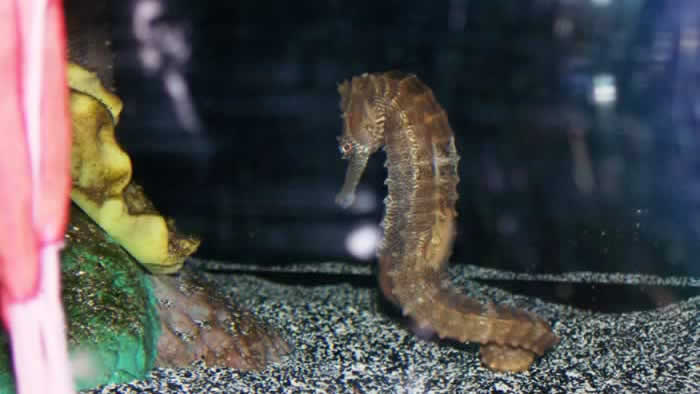
Over 40 different species of seahorses live in coastal habitats in the world’s oceans. With horse heads, monkey tails, vacuum mouths, and kangaroo pouches they may seem all mixed up, but they’re actually well-adapted to their habitats.
What They Eat
Seahorses are toothless predators. To eat, they suck in tiny animals like zooplankton and microscopic shrimp.
Where They Live
All seahorses require shallow coastal areas where there are plenty of things to hold on to and enough moving water to carry food to them. They are found in some of the most endangered ecosystems, including mangrove forests, coral reefs and sea grass meadows. The lined seahorses at the Minnesota Zoo are found in the western Atlantic Ocean from Novia Scotia south to Brazil, and through the Caribbean and Gulf of Mexico.
What They Do
Newborn seahorses drift with the ocean currents until they eventually settle in a new place. Adults stay close to home, often wrapping their prehensile tail around a blade of sea grass, a piece of coral, a sea sponge, or an underwater root in a mangrove. Males can spend their entire adult life within a 5-square-foot area and females range only slightly farther.
How They’re Doing
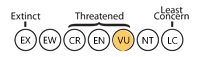
Lined seahorses are listed as “Vulnerable” to extinction. Like all seahorses, they are captured for sale as traditional medicine, souvenirs and for the aquarium trade. Their fragile habitats are often damaged by destructive fishing practices or by shrimp farming. Many governments regulate their trade, but population numbers remain low.
Where in the World
Africa
Asia
Australia
Central America & Caribbean
Europe
North America
Pacific Islands
South America
Habitat
Ocean
Conservation Status
Of 42 seahorse species, ten are doing well, one is near threatened, twelve are vulnerable, two are endangered and the rest are data deficient—demonstrating the need for more research.
Lined Seahorse
Animal Facts
Body Length: .45 – 14 inches, depending on the species
Taxonomic Category
Fish
Where at the Zoo
- Hippocampus erectus, the seahorse species at the Minnesota Zoo, is known by many different common names: Lined Seahorse, Northern Seahorse, Horsefish and Spotted Seahorse.
- Seahorses can change their shape and color during courtship, or to blend in to their environment. This makes it very difficult to identify species. In the last two decades, genetic testing has made it easier to identify different species. New species continue to be found.
- The smallest species of seahorse is Satomi’s pygmy seahorse in Indonesia, Brunei and Malaysia. It measures less than half an inch long. In contrast, the largest species is the big-bellied seahorse which can reach over one foot in length! It lives in Australia and New Zealand.
- Some seahorse pairs are monogamous and mate for life. Couples greet each other every morning with a dance that involves circling each other and may involve changing color. The dance is a way for the pair to strengthen their bond and synchronize their reproductive cycles.
- It’s the male seahorse that gets pregnant and gives birth! Females place their eggs in the male’s pouch, where they are fertilized and carried for several weeks.
- Just like other fish, a baby seahorse is called a fry.
- Seahorses can make noises during feeding and courtship. The noise can be heard underwater and is said to sound similar to a person smacking their lips.
- With excellent eyesight, seahorses use their vision to locate prey. They are able to move each eye independently, so they can see both backwards and forwards at the same time.
- Seahorses are always eating. Because their food passes through them so quickly, an adult may eat more than 30 times in a day!
- Poor swimmers, seahorses slowly propel themselves by fluttering the small fin along their back. The fin can flutter up to 35 times per second. They steer by using the small pectoral fins on either side of the head.