Southern Stingray
Hypanus americanus
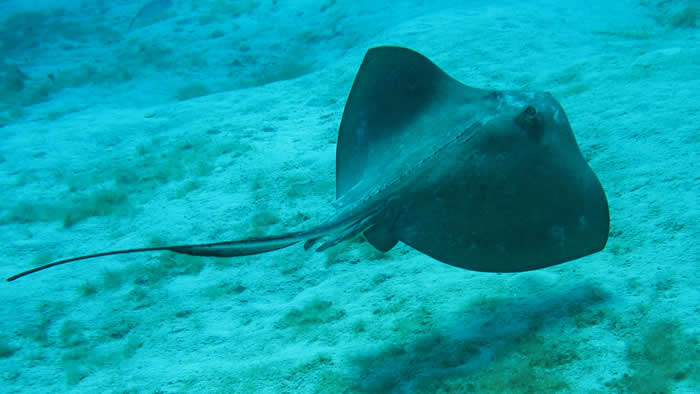
Southern stingrays have a flattened, disc-shaped body and long tail. Some stingrays have very round discs, whereas the southern stingray’s body looks more like a diamond from above. The tail, which can be twice as long as the body, has a serrated barb or spine that the stingray uses for defense.
What They Eat
With a mouth positioned on the underside of the body, these stingrays “graze” along the soft sea floor. They try to stir up prey such as smaller fish, mollusks, worms, shrimp and crabs. Since most of their food is buried, these stingrays will shoot water out of their mouth and flap their fins to uncover hidden prey.
Where They Live
These stingrays are found along the Atlantic coast from New Jersey, through the Gulf of Mexico and the Caribbean coasts, south to Brazil. Rarely found at depths of more than 175 feet, southern stingrays prefer seagrass beds and areas with a soft sand or silt bottom.
What They Do
A stingray is a fish, even though its body resembles a flattened disc, with eyes on top and a mouth on the bottom. Its fins move like wings as it swims through the water. Southern stingrays will sometimes partially bury themselves in sand with just their eyes sticking out. This is a good way to hide from predators, such as the hammerhead shark.
How They’re Doing
Not enough research has been done to assess the worldwide population of southern stingrays, although they appear to be fairly common. Stingrays are sometimes caught as bycatch, meaning they are unintentionally caught with more desirable fish.
- Southern stingrays are known to visit ‘cleaning stations,’ where fish called cleaner wrasse will remove the parasites from their bodies!
- Male stingrays are easy to differentiate from females because they have a visible clasper on either side of the tail base. The claspers are used during mating.
- A baby stingray is called a pup. At birth, southern stingray pups have a 7-inch disc width. Female southern stingrays give birth to 2-10 pups every year or two.
- Like their shark relatives, stingrays have special organs called ampullae of Lorenzini that help them sense electrical fields. This ability, along with strong senses of smell and touch, helps them locate prey buried beneath the sand.
- A stingray’s gills are on the underside of its body near its mouth. Holes near the eyes, called spiracles, draw water in, which is then expelled through the gills. A stingray can bury itself to hide in the sand, leaving only its spiracles and eyes poking out.
- Stingrays are named for the venomous barbs or spines on their tails which are used for defense.