Sheep
Ovis aries
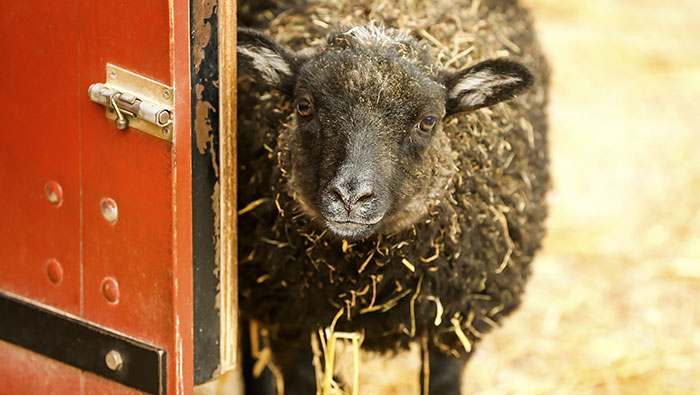
Domestic sheep are hooved mammals, or ungulates, with woolly coats. Sheep are ruminants, or ungulates that chew their cud and have an even number of toes. Cud is partially digested food that has been burped back up to the mouth before being passed along to another part of the stomach for further digestion. Domestic sheep are descended from European and Asian wild mouflon. People have raised sheep for about 10,000 years. More than 1,000 different breeds exist today.
What They Eat
Sheep are grazers, eating grasses, weeds, herbs and shrubs. On farms, they also eat corn, oats, barley and wheat. Sheep are able to survive with minimal water supplies, but must have salt in their diet.
Where They Live
Sheep live on all continents except Antarctica. The greatest numbers of sheep are found in Australia, New Zealand, South and Central America, and the United Kingdom. Different breeds are adapted to different habitats. Shetland sheep, for example, are a hardy breed, well-suited to the cold, wet, rugged Shetland Islands of northeastern Scotland.
What They Do
Sheep are social animals that live in groups called flocks. Flocks tend to move together, either led by a dominant sheep, a shepherd, or herd dog. This grouping behavior makes it easy for one person to take care of an entire flock. The safety provided by the flock allows a sheep to spend most of its day grazing, chewing its cud, or resting.
How They’re Doing
Domestic sheep are prized for their meat, fleece and milk. Sheep are not in danger of extinction. However, some breeds, such as the Hog Island Sheep, are rare. The Shetland sheep at the Wells Fargo Family Farm was previously a critically rare breed, but numbers are now increasing.
- Sheep belong to the family Bovidae. Other bovids at the Wells Fargo Family Farm include cows and goats. Takin and American bison can be found along the Minnesota Zoo’s Northern Trail.
- Sheep only have four incisors in the front of their bottom jaw and grinding teeth in the back. The top jaw lacks teeth in the front and instead has a firm dental pad.
- What’s the difference between lamb and mutton? Only the age of the animal producing the meat. Lamb comes from younger animals, while mutton is from older sheep.
- Sheep instinctively “follow the leader.” They are social animals that live in flocks. Sheep in a flock will follow the lead of a dominant animal.
- Like dogs, sheep pant when they are hot. Although goats are closely related to sheep, they lack the ability to cool down by panting.
- Shetland sheepdogs originated in the same place as Shetland sheep, on the Shetland Islands of Scotland.
- The wool on a sheep is constantly growing. Sheep are usually sheared (or shorn) in spring to remove the previous year’s wool growth before the summer heat sets in. The wool is usually removed in one large piece called a fleece. A single fleece weights 2-30 pounds, depending on the breed and size of sheep.
- One pound of sheep’s wool can produce as much as 10 miles of yarn!
- The fleece of Shetland sheep has the widest range of color and marking combinations of any breed. There are 11 recognized colors and 30 recognized markings. With so many colors and markings to choose from, Shetland wool is often kept undyed allowing it to retain its strength and softness.
- Ring shawls are shawls made from the finest Shetland wool—so fine that the woven shawl can pass through a ring. These beautiful shawls would traditionally be worn at a wedding.