
Goat
Capra hircus
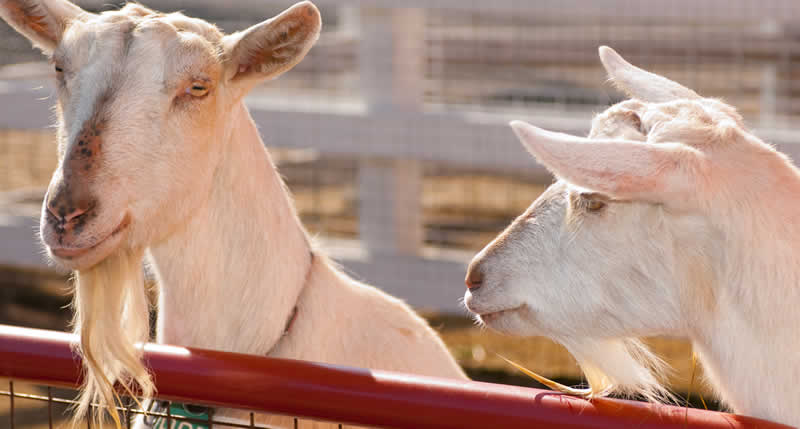
Goats were first domesticated 10,000 years ago in Asia. They provide milk, meat, fiber, hides and are used to help transport goods.
Goats are browsing herbivores, meaning they eat the leaves, soft shoots, or fruits of high-growing plants, shrubs and trees. They will reach up and around for their food, unlike sheep and cows which eat from the ground. Due to their four-chambered, ruminating stomach, goats can digest plants that other animals cannot. Similar to cows, goats can be seen chewing their cud—partially digested food that has come from one of the stomach chambers prior to moving on to the next stomach chamber. On farms, goats are typically fed hay and alfalfa, along with cracked or ground corn mixed as a supplement.
Worldwide, the majority of domestic goats live in Asia. However, goats are found on every continent, except Antarctica. They prefer mountainous areas as their wide, cloven hooves allow them to climb steep rocks with ease.
Goats spend much of their time eating food and chewing their cud. They eat enough brush to manage the land and prevent overgrowth. As they travel, goats deposit cold manure which composts faster and attracts fewer flies than the feces of other animals.
With approximately 450 million animals worldwide and 200 distinct breeds, goats are among the world’s most numerous domestic animals. They are easy to care for and provide a variety of valuable goods. Some domestic goat breeds, such as the Arapawa in New Zealand are extremely rare.
- Goats belong to the family Bovidae. Other bovids at the Wells Fargo Family Farm include cows and sheep. Takin and American bison can be found along the Minnesota Zoo’s Northern Trail.
- Goats are prized for their ability to eat weeds bushes and vines, thus clearing land for farming. They can digest plants that many other herbivores can’t eat.
- Around the world, more people drink goat’s milk than cow’s milk—or the milk of any other single animal.
- Goat’s milk is naturally homogenized, meaning it doesn’t separate out into layers in its original state. It’s easier to digest than cow’s milk, even by people who are lactose intolerant. It’s also higher in calcium and vitamin A.
- Historians believe domestic goats were aboard the Mayflower in its 1620 voyage bringing Europeans to North America.
- Like many hooved animals, the pupils in a goat’s eye are rectangular. This gives them vision for 320-340 degrees around them without having to move their head. They are also thought to have excellent night vision.
- Goats are burpers! This is due to the role of their rumen. The rumen acts as a fermentation vat which naturally produces gas. That gas escapes in the form of loud, healthy burps.